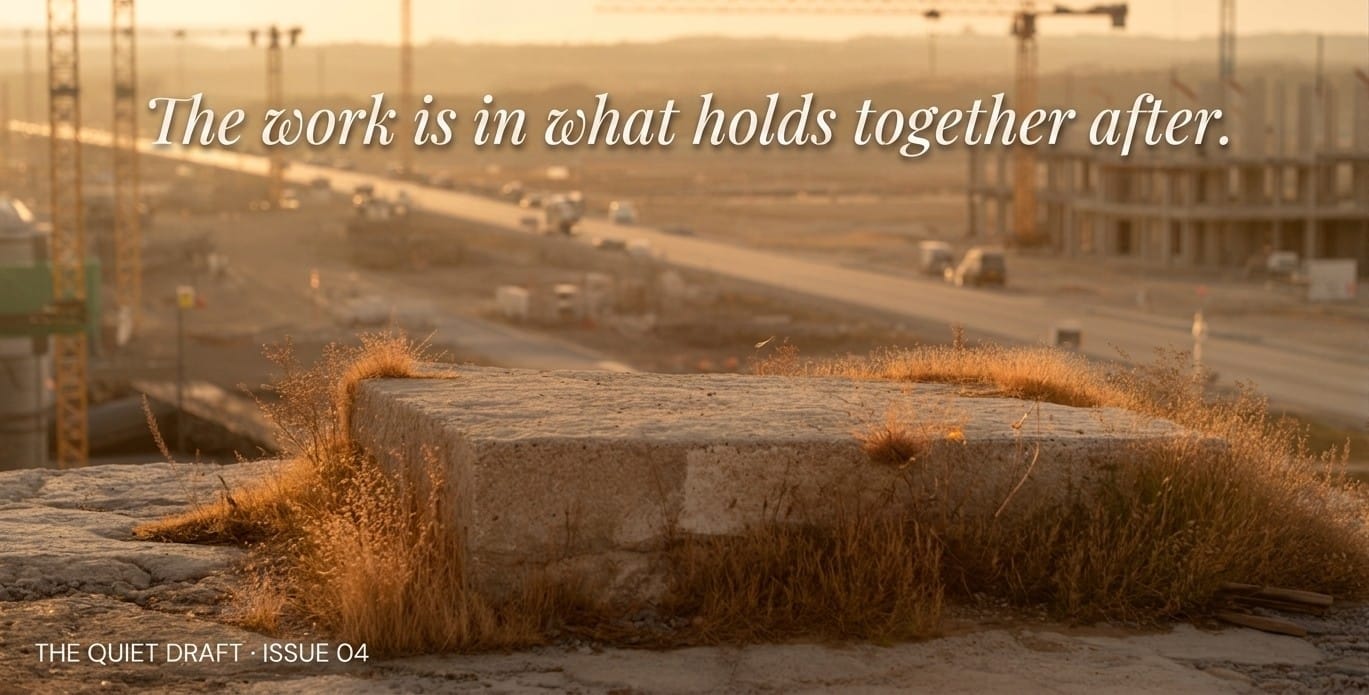
In September 2017, Prime Minister Modi and Japanese Prime Minister Abe stood together in Ahmedabad and laid the foundation stone for India’s first high-speed rail corridor — Mumbai to Ahmedabad, 508 kilometres, a target completion of 2022. The foundation stone is still there. The corridor is not. The target moved to 2023, then to the late 2020s. What changed was not the ambition. What changed was what always changes: land acquisition ran long, tenders ran long, the gap between a ceremony and a construction reality made itself known. The foundation stone is a perfectly sincere object. The calendar it was laid on was not the calendar the project would actually run on.
This is the closing essay of a season I began with a single argument: that the most consequential planning decisions in India are the slow ones, and the slow ones are the ones we are least equipped to wait for. I wrote about urgency as pathology. About standards encoded quietly across decades. About the difference between time as a constraint and time as a medium. What I did not name directly — what ran underneath all of it — is that India runs on two calendars simultaneously, and they do not agree.
The first calendar is electoral. Five years for a Lok Sabha government. Five for most state assemblies. Less in practice, because the last year before an election is dominated by inauguration logic, not planning logic. The second calendar is infrastructural. A metro line takes seven to fifteen years. A port takes a decade and then another for it to mature into the trade volumes its design assumed. A national highway corridor takes longer than two governments. A regulatory authority takes a generation to develop genuine institutional capacity. These are not bugs. These are the actual horizons over which infrastructure has to be built, tested, and trusted.
The mismatch produces three predictable distortions — the most visible ones; the Deep Read has the fuller structural account. Projects get inaugurated half-built, because the alternative is letting a successor cut the ribbon. Projects get rebranded when governments change — the scheme name changes, the acronym changes, the launch event happens again — and the rebranding is presented as policy innovation rather than continuity. The institutional memory embedded in the previous programme — the officers who understood its design logic, the field data from its early years — quietly disappears. And projects get abandoned when their political parents leave office, even if the engineering was sound, because no one rises politically by completing a predecessor’s vision.
There is a mechanism that makes this worse, and it almost never appears in discussions about infrastructure delays. The Model Code of Conduct — the Election Commission’s set of rules governing government behaviour during elections — freezes new project announcements, new scheme launches, new transfers, and many categories of approval for the duration of an electoral cycle. This is a good rule, designed to prevent incumbent governments from using state machinery to influence elections. But India is perpetually in some election. Lok Sabha every five years, state assemblies staggered through the calendar, local body elections, by-polls, and Union Territory elections together mean that at any given point, the MCC is active somewhere in the country and at least partly freezing the administrative machinery of at least one government. Infrastructure that requires inter-governmental coordination — a freight corridor that crosses three states — can find itself in a slow-motion pause that has nothing to do with engineering.
There are exceptions, and they are instructive. The Delhi Metro succeeded partly because it was built behind an institutional firewall — the Delhi Metro Rail Corporation, created in 1995 as a Special Purpose Vehicle (SPV) vested with autonomy over procurement, hiring, contracting, and execution. DMRC was designed explicitly to avoid the fate of the Kolkata Metro, which had taken decades and run far over budget due to what its own post-mortems described as political interference and bureaucratic churn. DMRC’s first Managing Director served for sixteen years — an extraordinary tenure that insulated the project across three state governments and two central governments. Phase I was delivered three years ahead of schedule. The model worked.
The Nagpur Metro tells a more recent version of the same story. Maha-Metro — Maharashtra Metro Rail Corporation Limited — was structured on the DMRC model: a 50:50 centre-state SPV with operational autonomy. Foundation stone in August 2014. First commercial section operational in March 2019. Full Phase I in December 2022. Roughly eight years from political decision to complete operational network. The institutional model provided the structure. The political alignment provided the stability across the construction window. Both were necessary. Neither was sufficient alone.
Contrast this with the Kolkata East-West Metro — first proposed in 1921 by British engineer Sir Harley Hugh Dalrymple-Hay, sanctioned in 2008-09, partially operational now, after over a century of planning, alignment shifts, political transitions, and engineering challenges that were genuinely hard but not harder than what DMRC faced under the Yamuna. The difference was not the geology. It was the consistency of backing across electoral cycles.
India has begun to name this problem formally. The High Level Committee on Simultaneous Elections, chaired by former President Ram Nath Kovind, submitted an 18,626-page report in March 2024. Its central argument: because India’s electoral cycles are staggered across Lok Sabha and state assemblies, the country lives in a state of permanent electoral mode, and governance — including infrastructure governance — is permanently distorted by it. The committee recommended synchronising Lok Sabha and state assembly elections in a first phase, followed by local body elections within 100 days. The Constitution (129th Amendment) Bill — which proposes to amend the Constitution to align Lok Sabha and state assembly terms for simultaneous elections — was introduced in the Lok Sabha in December 2024 and referred to a Joint Parliamentary Committee: a bipartisan, ad-hoc body drawn from both Houses that scrutinises bills in detail and submits advisory recommendations. Its recommendations are not binding on the government.
The case for simultaneous elections, from an infrastructure planner’s perspective, is real. A longer uninterrupted governance window is genuinely better for long-cycle projects. But the objections are also structural, not merely political. A no-confidence motion can still bring down a government mid-term. Article 356 can still dissolve a state assembly. The historical record of simultaneous elections — India held them from 1951 to 1967, then lost them when state assemblies began to be dissolved prematurely — suggests that synchronisation is easier to propose than to sustain. And even if simultaneous elections work perfectly, a corridor spanning multiple state jurisdictions still faces misaligned political cycles at some layer of authority.
The financial world has developed its own answer to this problem, and it is worth naming. Concession agreements for infrastructure projects — the contracts that bind private operators to build and run roads, ports, corridors — run for twenty-five to thirty years. Five to six electoral cycles. The shift from Build-Operate-Transfer models to the Hybrid Annuity Model for national highways was partly an engineering of political risk: the HAM structure reduces the private operator’s exposure during construction, which is when political disruptions are most damaging. The rise of Infrastructure Investment Trusts is another version of the same logic. A developer transfers completed operational assets — toll roads, power transmission lines — into the InvIT trust structure, which lists on the stock exchange and raises capital from investors. The developer receives cash and redeploys it into new construction. Each asset is held inside a separate SPV that owns the concession agreement; that SPV is legally isolated from the developer’s balance sheet, so even if the developer faces financial distress, the asset’s cash flows continue to flow to unitholders under the trust deed. This ring-fencing holds primarily through construction and early operations. A new government can still renegotiate toll rates, delay annuity payments, or modify concession terms — operational cash flows are not fully insulated from political decisions — but the structural separation is substantially greater than under direct developer ownership. Private capital has been quietly building hedges against the two-calendar problem for decades. The policy world has been slower to catch up.
The deeper question this season has circled is not whether India can build infrastructure. It demonstrably can. The question is whether it can build the institutional and financial architecture that makes infrastructure durable across political transitions. The vision documents — PM GatiShakti, the National Infrastructure Pipeline, Viksit Bharat 2047 — are attempts to hold time across politics by writing it down at a horizon no current government can fully claim. Whether that holds is something we will only know in hindsight.
What runs underneath all of it — beneath the concession agreements, the SPV structures, the simultaneous elections proposals — is a simpler question that India has not answered cleanly. In a democracy that runs on five years, how do you build the institutions that need fifty? The foundation stone is easy. Anyone can lay one. The work is in what holds together after the ceremony ends and the principals go home.
That work, it turns out, is not only an engineering problem or a financial one. It is an institutional one. The infrastructure we have been discussing this season — the standards, the corridors, the regulatory frameworks — requires, at every point, something that does not appear in any NIP spreadsheet: organisations that know what they are doing, governments that can make decisions and be held to them, people who have been trained not just to build but to operate, regulate, and sustain what gets built. India has made extraordinary progress on the first part of that sentence. The second part is the open question. Whether the institutions match the ambition, whether the governance holds the loop together, whether the people are ready — that is the work Season 2 will try to account for.
— — —
The Deep Read for this issue covers five additional sections: the two-calendar mechanisms in full, the DMRC institutional model and its limits, how private capital structures around electoral risk, the simultaneous elections debate and its historical precedent, and what the two-calendar problem means for Viksit Bharat 2047.
Write to thequietdraft.admin@gmail.in if you’d like it.